Forearm Pump on Course Is Partly a Breathing Problem
Quick Answer: Forearm pump comes from occluded blood flow in a sustained contraction. Breath-holding raises intrathoracic pressure and further restricts venous return, so the pump arrives faster and clears slower. Deliberate exhalation during grip work measurably extends time on the rig.
You trained grip all winter, your dead hang is over 90 seconds, and you still fall off the rig at obstacle four. The gap is not strength, and adding more hangs will not close it.
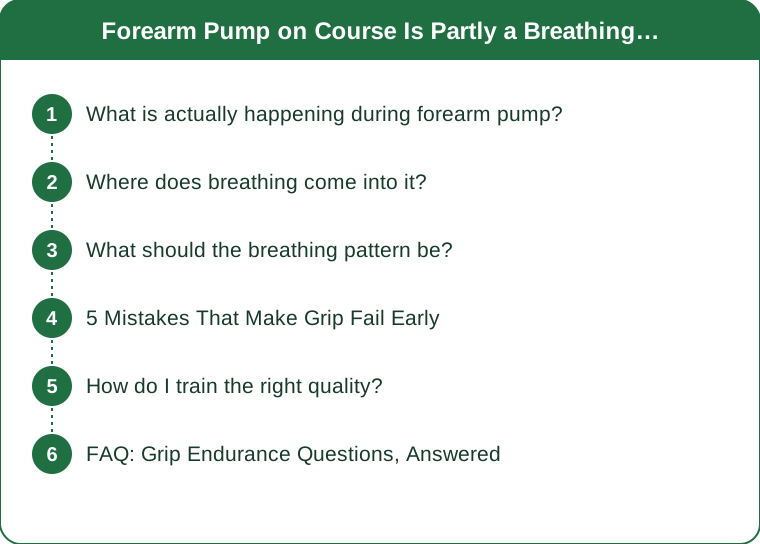
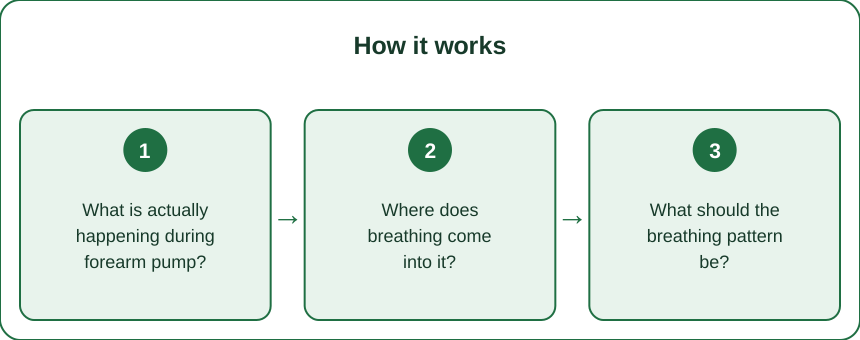
What is actually happening during forearm pump?
A sustained grip contraction at moderate to high intensity partially occludes blood flow through the forearm. Above roughly 50-60 percent of maximum voluntary contraction, flow drops substantially.
Metabolites accumulate because they cannot be cleared, which produces the swelling and burning sensation and, critically, a rapid loss of force capacity.
The recovery mechanism is reperfusion, which requires relaxation. This is why intermittent grip lasts far longer than continuous grip at the same total time under tension.
Where does breathing come into it?
Breath-holding, which happens almost reflexively during hard grip efforts, creates a Valsalva-like pressure increase in the chest.
Elevated intrathoracic pressure impedes venous return from the extremities. That means the blood already trapped in a pumped forearm has an even harder time getting out.
So the two effects compound. Occlusion at the muscle plus impaired return at the chest produces a pump that arrives sooner and lingers longer. Deliberate rhythmic breathing on the rig is free and it works within a single session.
What should the breathing pattern be?
Simple and forceful enough to be automatic under stress.
- Exhale on each transition, every hand movement
- Keep the exhale audible so you can verify it under fatigue
- Never hold through more than one rung
Audible is the key detail. Silent breathing degrades to breath-holding within about fifteen seconds of hard effort, and you will not notice. If you can hear yourself, you are breathing.

5 Mistakes That Make Grip Fail Early
1. Over-gripping from the first rung. Most racers grip at near maximum from the start. Grip only as hard as required to not slip, which on most rigs is far less than people use.
2. Static hanging between movements. Every second stationary is a second of occlusion with no progress. Move continuously; momentum costs less grip than hanging does.
3. Training only dead hangs. Dead hangs build isometric endurance in one position. Rigs demand repeated release and re-grip, which is a different quality entirely.
4. Chalking excessively. Over-chalking dries the skin and reduces friction after the first few obstacles, which makes you grip harder to compensate.
5. Ignoring shoulder position. Hanging with fully relaxed, disengaged shoulders forces the hands to do all the work. A slight active scapular set transfers load up the chain, and this is the one that surprises people who have trained grip for months.
How do I train the right quality?
Train intermittent grip with breathing, not just longer hangs.
Session A: rig traverse intervals, 20 seconds on, 40 seconds off, 8 rounds, breathing audibly on every transition
Session B: farmer carries, 40 meters, 4 sets, focusing on relaxed grip and continuous breathing
Session C: repeat re-grips, hanging and releasing one hand at a time for 30 seconds, 5 sets
Two of these per week alongside your normal training is enough. Add a specific rig session in the final six weeks before a race, because the skill is highly specific and does not transfer from carries alone.
This is general information, not medical advice. Numbness, tingling, or forearm pain that persists after training deserves a professional evaluation.
FAQ: Grip Endurance Questions, Answered
Does grip strength training help at all?
Yes, because a stronger grip means any given rung is a lower percentage of your max, which delays occlusion. It is necessary and not sufficient.
How long should recovery between rigs be?
Reperfusion of a heavily pumped forearm takes two to four minutes of relaxed arms. Shaking out for 20 seconds is not enough, so plan course pacing around it.
Do grip trainers help?
Spring grippers build crushing strength, which is only part of the demand. Hanging and carrying transfer far better to rig performance.
TL;DR:
- Pump is occlusion; breath-holding worsens it by impeding venous return
- Exhale audibly on every hand transition and never hold through more than one rung
- Grip only as hard as needed and keep moving instead of hanging static
- Train intermittent re-grips, not just longer dead hangs
On your next rig session, make every exhale audible and count how far you get compared to last time. The difference from breathing alone is usually large enough that people assume they must have been fresher that day.
Keep Reading
This article is for general informational and styling purposes only. Fit, sizing, and product availability may vary.