Why Your Race Falls Apart on the Running Between Obstacles, Not the Obstacles
Quick Answer: In a typical obstacle race, 60 to 80 percent of your total time is spent running, not on obstacles. But almost all training attention goes to the obstacles, because they are the memorable part. The result is an athlete whose grip and upper body are ready and whose aerobic base is not, and the failure shows up as arriving at obstacles already redlined. The obstacle you fail is usually not the obstacle that beat you — the running before it was.
You remember the rig. You do not remember the 800 metres of uneven grass that came before it.
Your body remembers both, and it weighted them very differently.

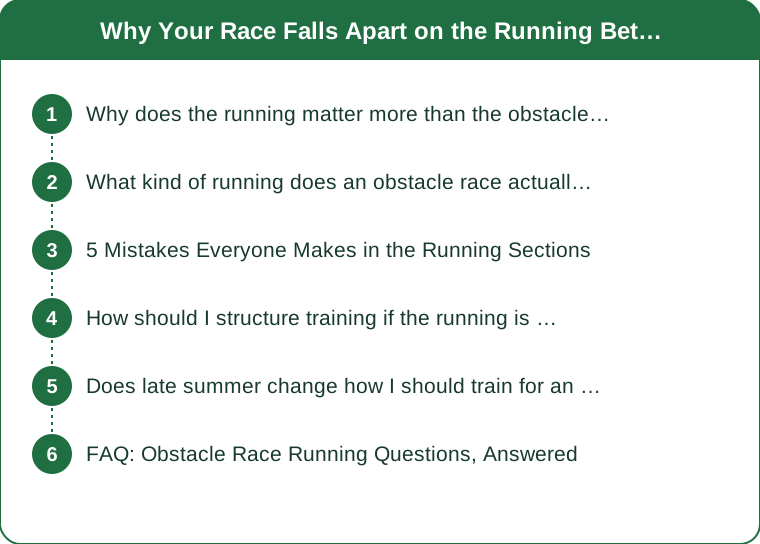
Why does the running matter more than the obstacle count suggests?
Because of how the time actually distributes.
On a 5K obstacle course with 20 obstacles, most obstacles take 15 to 60 seconds each. Call it 12 minutes of obstacle time, generously. The rest — often 35 to 50 minutes for a mid-pack finisher — is running, walking and climbing terrain.
So the discipline that occupies three quarters of the race gets a quarter of the training.
Worse, the two interact. Grip endurance falls off sharply when you are near your aerobic ceiling. Arriving at a rig with your heart rate at 180 and your breathing out of control does not just make the rig harder, it makes it a different task. Your forearms are competing for blood flow with everything else.
This is why people can hang from a bar for 90 seconds fresh and fail at 20 seconds in a race. Nothing about their grip changed.
So should I stop training obstacles?
No. But the ratio should look more like the race: mostly running, with obstacle work layered on top of fatigue rather than practised fresh.
What kind of running does an obstacle race actually demand?
Not the kind most people train, which is the second problem.
It is broken running. You run 400 metres, stop, exert hard for 30 seconds with your arms, then run again. Your heart rate never settles into a steady state. A training plan built on continuous flat runs prepares you for a race you are not doing.
It is uneven terrain. Grass, mud, ruts, hills, and often a course that goes deliberately up the ugly side of a field. Ankle and foot stabilisers work far harder than on road, and they fatigue on a schedule of their own.
It is uphill-heavy. Race organisers use elevation because it is free difficulty. Hills between obstacles are the single most common place people switch to walking and never switch back.
And it is done carrying a heart rate you did not choose. After a heavy carry, your first 200 metres of running are at a much higher cost than the pace suggests.
What to do about it:
- Run on grass and trail at least once a week, not just road.
- Practise the transition, not just the pieces. Ten burpees then run 400m, repeated, teaches your body something a steady 5K never will.
- Train hills specifically. Short, repeated, and by effort rather than pace.
5 Mistakes Everyone Makes in the Running Sections
Starting too fast because the first kilometre has no obstacles. The opening stretch is usually deliberately clear so the field can spread out. It feels easy, everyone goes out hard, and the cost is paid at obstacle four. Your first kilometre should feel almost embarrassingly conservative.
Sprinting to obstacles. People accelerate on the approach because the obstacle is where the excitement is. This arrives you at a grip task with your heart rate spiked. Slow down in the last 50 metres, deliberately, and shake your arms out. You will lose four seconds and save forty.
Walking the wrong hills. Walking is a legitimate strategy on steep climbs — the energy cost of running a steep grade is much higher for very little speed. The mistake is walking the shallow ones, where running is cheap and walking bleeds minutes. Pick your walking hills before you are tired.
Standing still in queues. Waiting for a busy obstacle lets your heart rate drop and your legs cool. That feels like recovery and it is actually the reason your first steps afterwards feel terrible. Keep moving, even shuffling on the spot.
Ignoring the downhills. Downhill running on wet grass is where most race injuries happen, and it is also free speed if you can do it. Shorten your stride, increase your cadence, and stay off your heels. Most people brake the whole way down and take the impact anyway.

How should I structure training if the running is the gap?
A workable weekly shape for someone with four sessions available:
- One longer easy run, 45 to 75 minutes, on trail or grass where possible. This builds the aerobic base that everything else sits on. Conversational pace throughout, no exceptions.
- One hill or interval session. Hill repeats of 60 to 90 seconds hard, walk down to recover, 6 to 10 rounds. Or 400m repeats with 90 seconds rest.
- One combined session. This is the race-specific one and the one most people skip. Alternate 400 to 800 metres of running with an obstacle-like effort: farmer’s carries, sandbag carry, dead hangs, bucket carry, burpees. 6 to 8 rounds. The point is to practise running on ruined arms and gripping on a ruined engine.
- One strength session, focused on grip, pulling, carries and single-leg work. Deadlifts, pull-ups or negatives, loaded carries for distance rather than time.
And a piece of pacing practice that costs nothing: on your long run, practise deliberately dropping your effort for the last 50 metres before a landmark, as if it were an obstacle approach. It feels pointless in training. It is worth minutes on race day.
How far out should I change this?
Eight weeks is enough to move the aerobic side meaningfully. Four weeks is enough to fix pacing habits, which is the cheaper win of the two.
Does late summer change how I should train for an autumn race?
Yes, in two specific ways, and both are on a clock right now.
Heat is currently inflating your effort readings. Training in late August humidity means your heart rate at any given pace runs higher — commonly 5 to 15 beats per minute higher than the same effort in cool conditions. If you set your race pacing off summer heart rate data and race in October, you will under-race yourself, because your body will feel capable of more than the numbers suggest.
The fix: train by perceived effort as well as heart rate through the transition, and expect your paces to improve in cooler air without any fitness change.
And the terrain is about to change under you. Autumn courses are wet where summer courses were firm. Grass that gripped fine in August becomes a skating rink after two days of rain. Practise on wet grass on purpose, at least twice, before racing on it. Footwear that was adequate all summer may not be.
A few season-specific notes:
- Your warm-up needs to get longer as mornings cool. A 10-minute warm-up that worked in August is not enough at 8 degrees.
- Cold hands destroy grip strength disproportionately, and autumn races start early. Keep your hands warm right up to the start.
- Water crossings hit differently in autumn. The temperature shock is real and it will take your breath control away for a minute or two. Expect it rather than being surprised by it.
This is general information, not medical advice. If you have a heart condition or are new to intense exercise, speak to a doctor before starting a race-training plan.
FAQ: Obstacle Race Running Questions, Answered
Is it cheating to walk?
No, and the fastest racers do it. Walking steep climbs at a strong hiking pace is often faster per unit of energy than running them. The skill is choosing which hills.
Do I need trail shoes?
For anything muddy, yes. The difference between an aggressive lug pattern and a road shoe on wet grass is enormous, and it affects safety as much as speed.
How do I stop my heart rate spiking on obstacles?
Mainly by arriving with it lower. Beyond that, exhale deliberately during exertion rather than holding your breath, which is the single most common cause of a spike on carries.
Should I train burpees?
Only enough to survive the penalty. Time spent training burpees is usually better spent on the skill that would have avoided them.
TL;DR:
- Running is 60 to 80 percent of race time and usually gets a fraction of the training.
- Grip fails at obstacles mostly because you arrived redlined, not because grip is weak.
- Train broken running on grass and hills, not continuous flat road.
- Slow down deliberately in the last 50 metres before every obstacle.
- Walk the steep hills, run the shallow ones, and decide which is which before you are tired.
- Late summer heat inflates your heart rate — race-day cool air will feel easier than your training data predicts.
The rig gets the photo. The half mile of nothing before it decides whether you get up on it.
Keep Reading
This article is for general informational and styling purposes only. Fit, sizing, and product availability may vary.