Why You Crush the Rig in Training and Fail It on Race Day
Quick Answer: Rig training fails to transfer because you always practice it fresh, dry, and unhurried, while on race day you arrive at the rig with elevated heart rate, pumped forearms, wet hands, and no recovery time. The obstacle is the same; your arrival state is not. Training the two minutes before the rig transfers better than more time on the rig.
You do the rig clean every Tuesday.
On race day you touched the third ring and your hand just opened.

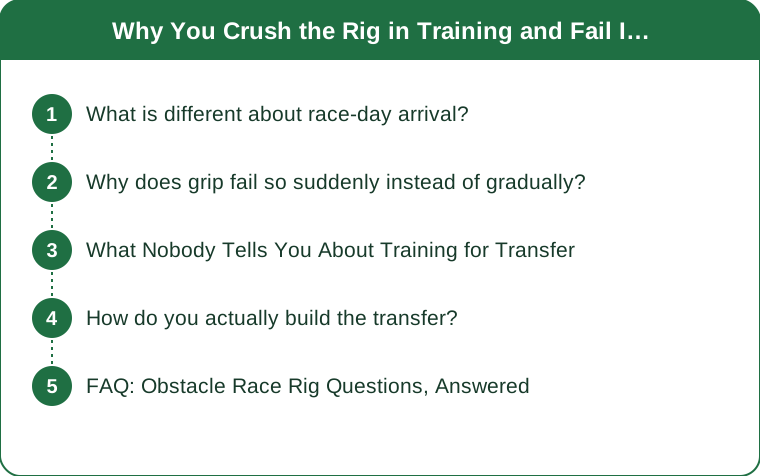
What is different about race-day arrival?
Four things change, and each one costs you grip independently.
You arrive at 85 percent of max heart rate. In training you approach the rig having stood around. In a race you have been running. Blood is prioritized to your legs and lungs, and forearm blood flow — the thing that clears metabolites from working grip muscles — is reduced when you need it most.
Your forearms are already partially fatigued. Carries, walls, ropes, and even arm swing during running all deposit fatigue in the forearms before you ever reach the rig. You start the obstacle at 70 percent capacity, not 100.
Your hands are wet, muddy, or both. Friction is not a fixed value. Wet skin against a wet bar drops the coefficient of friction dramatically, which means the same grip force produces far less holding.
Your breathing is wrong for grip. Hard breathing means you cannot brace, and an unbraced torso lets your body swing, which means your hands must do stabilizing work on top of holding work.
You have one attempt. In training you rest and retry. Race day removes the safety net your practice quietly depended on.
Why does grip fail so suddenly instead of gradually?
Because grip endurance is not linear — it has a cliff.
Forearm flexors work largely in an isometric hold. A sustained contraction restricts its own blood supply. Above roughly 50 to 60 percent of maximum grip force, blood flow to the muscle is substantially reduced by the contraction itself.
Metabolites build with no way out. That is the pump — the swollen, hot, useless feeling. It arrives fast because the clearance mechanism is the same circulation the contraction is squeezing shut.
Once the pump peaks, force drops off a cliff. You do not gradually weaken. You go from holding fine to your hand physically opening in under ten seconds, which is why almost every rig failure feels like a surprise.
Recovery is slower than you think. Meaningful grip recovery takes 60 to 90 seconds of low-tension arm movement. Ten seconds of shaking out does very little, which is why the shake-out at the base of the rig rarely saves anyone.
The fix is upstream. You cannot out-strength a circulation problem inside the obstacle. You have to arrive with less accumulated fatigue.

What Nobody Tells You About Training for Transfer
The two minutes before the obstacle matter more than the obstacle. Almost nobody trains the approach, and the approach is where race day differs from practice. Run 400 meters hard, then immediately do the rig. Your first attempt will be humbling and honest.
Practicing wet is not optional in the fall. Late-season races mean cold rain, wet bars, and numb fingers. If every practice session is dry and 70 degrees, you have trained a different sport. Hose the bars. Wet your hands. It is unpleasant and it is the point.
Fresh volume can make the transfer problem worse. More clean, rested reps builds confidence that race conditions will not honor. It also teaches a rhythm — deliberate, controlled, unhurried — that falls apart under a racing heart rate.
Speed through the rig beats strength on it. Time under tension is the enemy. The racer who moves decisively at 80 percent technique often clears what the careful, precise racer fails, because the careful one spent 40 seconds hanging.
Breathing is trainable and almost never trained. Practice a forced exhale at each hand transition. It sounds trivial. It measurably delays the pump because it stops the breath-holding that spikes intra-thoracic pressure and restricts flow.
How do you actually build the transfer?
Change the conditions, not the volume.
Do 3 sets of run-then-rig. 400 meters at race pace, straight onto the rig, no pause. Rest 3 minutes between sets. Three sets is enough — this is quality work, not conditioning.
Add a pre-fatigue block once a week. Farmer’s carry 40 meters heavy, drop, then rig. This mimics arriving with forearms already loaded, which is the actual race sequence.
Train hand replacement speed separately. Time yourself across the rig. Cut your best time by 15 percent and treat that as the target, even if it costs you some control.
Practice the fall. Knowing how to drop safely and immediately at the point of failure saves the shoulder injuries that come from hanging on past the cliff.
Cold-weather note: as races move into October and November, cold hands lose fine motor control before they lose strength. Keep hands warm in the corral, and do 30 seconds of hard fist opening and closing in the last minute before the wave starts. This is general information, not medical advice — shoulder and elbow pain that persists after a race is worth having looked at.
FAQ: Obstacle Race Rig Questions, Answered
Should I train grip more often to fix this?
Usually not. Most racers who fail the rig on race day already have adequate maximal grip strength — they demonstrated it in training. Adding volume tends to leave you with chronically tired forearms. Train the arrival conditions instead.
Do gloves help?
In wet conditions, sometimes, but they cost you feel and add bulk that makes some grips harder. Most experienced racers use grip aids or nothing rather than full gloves. Test in training before you test in a race.
How long before the rig should I ease off running?
About 30 to 60 seconds of controlled, easier running before the obstacle noticeably lowers heart rate and gives forearms a small window of restored flow. Racers who sprint into the rig to save time usually lose more than they gained.
TL;DR:
- Rig failure on race day is an arrival-state problem, not a strength problem
- Elevated heart rate, pre-fatigued forearms, and wet hands each cut grip independently
- Grip fails on a cliff, not a slope, because the contraction restricts its own blood supply
- Train run-then-rig, carry-then-rig, and wet-hand reps instead of more fresh volume
- Move faster through the rig; time under tension is what actually beats you
The rig you clear every Tuesday and the rig at mile four are technically the same obstacle and functionally two different tests. Once you start training the second one, race day stops being a surprise.
Keep Reading
This article is for general informational and styling purposes only. Fit, sizing, and product availability may vary.