Why Your Grip Actually Fails on Obstacle Courses (It's Not Weak Hands)
Quick Answer: Grip fails on obstacle courses mostly from forearm endurance running out over hours, not raw hand strength. Train sustained hangs and grip-under-fatigue, not just max-strength grippers, and it lasts far longer on race day.
You can deadlift respectably and still fall off the rig at obstacle 9. That gap confuses a lot of first-time racers — it’s not that your hands are weak, it’s that nobody trained them to work tired.

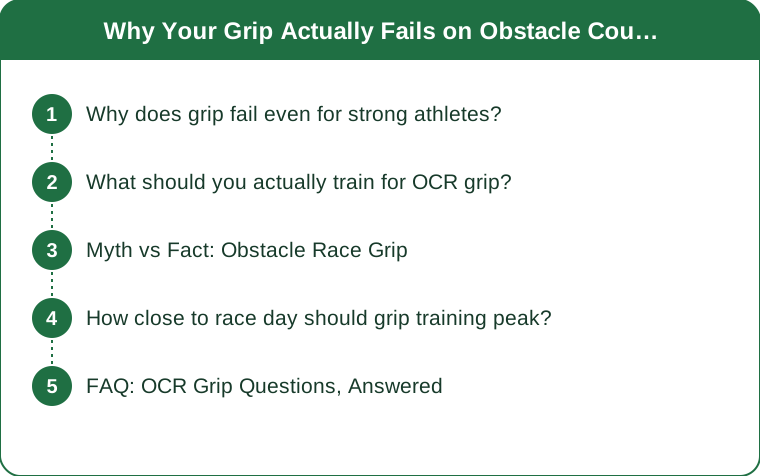
Why does grip fail even for strong athletes?
Because max grip strength and grip endurance are different systems. A strong one-rep grip test doesn’t predict how your forearms perform after 5 miles of running and 8 obstacles already draining them.
OCR grip failure is almost always local muscular fatigue in the forearm flexors, not a lack of raw strength — which is why the fix is endurance work, not heavier grippers.
What should you actually train for OCR grip?
- Dead hangs: build to 60-90 seconds, then add fatigue by hanging after a run
- Farmer’s carries: 40-60 seconds under load teaches grip to work while everything else is tired
- Towel or fat-grip pull-ups: thicker grip diameter builds forearm endurance faster than standard bars
- Grip-specific fatigue circuits: hang, drop, run 200m, hang again — mimics the actual race demand

Myth vs Fact: Obstacle Race Grip
Myth: Chalk fixes grip failure. Fact: Chalk helps with sweat, not fatigued forearms — it buys you maybe 10% on a course where the real problem is muscular endurance.
Myth: Bigger forearms mean better grip. Fact: Endurance capacity matters more than size — many strong-looking lifters gas out on obstacle 6 because they never trained sustained holds.
Myth: You should train grip separately from running. Fact: The actual failure mode is grip-after-running-fatigue, so the most race-specific training combines the two.
How close to race day should grip training peak?
Build grip endurance volume for 4-6 weeks, then taper the last 7-10 days like any other training block — sore, fatigued forearms on race morning undo the whole prep. The last hard grip session should land at least a week out.
FAQ: OCR Grip Questions, Answered
How long should I be able to dead hang for OCR?
60 seconds fresh is a solid baseline for most amateur-level courses; elite racers train well past 90 seconds.
Does forearm size correlate with OCR grip performance?
Not strongly — endurance capacity and technique (how you grip, not how hard) matter more than muscle size.
What’s the fastest way to improve grip in a short training window?
Farmer’s carries 2-3x a week for 4 weeks show up fast — they train the exact fatigue pattern a race demands.
TL;DR:
- Grip fails on OCR courses from forearm endurance, not max strength
- Dead hangs, farmer’s carries, and fat-grip pull-ups build the right capacity
- Train grip after running fatigue — that’s the actual race condition
- Peak grip volume 4-6 weeks out, taper the final week
Stop training for a one-rep grip test and start training for hour three.
Keep Reading
This article is for general informational and styling purposes only. Fit, sizing, and product availability may vary.