Why Your Grip Fails Before Your Legs Do in an Obstacle Race
Quick Answer: Forearm grip muscles are small relative to the leg’s large muscle groups, so they accumulate metabolic fatigue and lactate far faster under sustained load, which is why hands fail well before legs feel tired during hanging or carrying obstacles — dedicated grip endurance work (dead hangs, farmer’s carries, thick-bar training), not more running, is what actually raises the ceiling on obstacle race performance.
Running more miles rarely fixes a grip that gives out on the rig, because the muscle actually failing isn’t the one training is targeting.

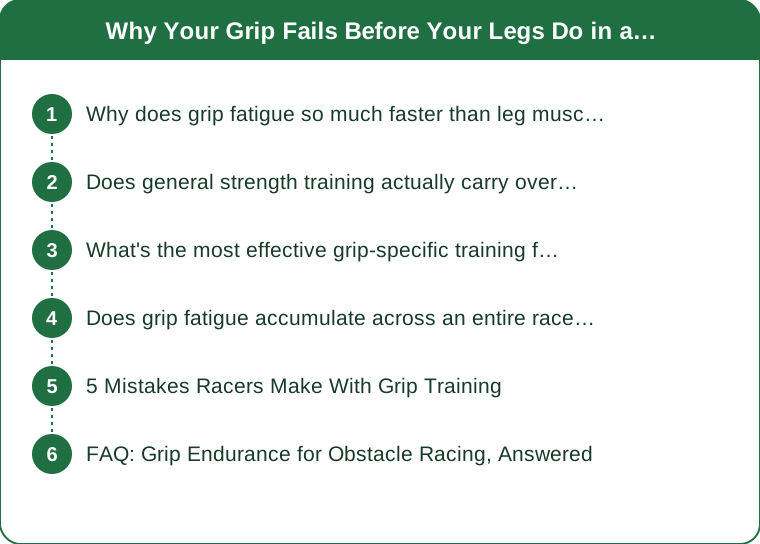
Why does grip fatigue so much faster than leg muscles during the same race?
Forearm and hand muscles are small relative to the large leg muscle groups, with a much smaller cross-sectional area and blood supply to clear metabolic byproducts like lactate during sustained isometric contraction. A sustained hanging grip is also isometric, which restricts blood flow to the working muscle far more than the rhythmic, blood-flow-friendly contraction pattern of running, so grip muscles fatigue on a fundamentally faster timeline than legs do.
Does general strength training actually carry over to obstacle-specific grip endurance?
Only partially — general grip strength (like a strong handshake) and grip endurance under sustained load are different qualities, and standard weightlifting with straps or thick gym-bar grips doesn’t always transfer well to the thin bars, ropes, and wet surfaces obstacle races actually use. Training grip specifically under fatigue and with race-relevant implements produces far more race-day carryover than general strength work alone.
What’s the most effective grip-specific training for obstacle racing?
Dead hangs held to near-failure, farmer’s carries for distance rather than just weight, and thick-bar or towel-grip variations most closely replicate the sustained, fatigued grip demand of an actual race. Training grip at the end of a workout, when overall fatigue is already present, more accurately simulates the state hands are actually in by the time a race’s rig obstacles show up.

Does grip fatigue accumulate across an entire race, or reset between obstacles?
It accumulates significantly across a race — grip strength measured after several miles of running and multiple obstacles is measurably lower than fresh grip strength, since the small forearm muscles don’t fully recover in the minutes between obstacles the way legs can partially recover during easier running sections. This is part of why grip specifically tends to become the limiting factor later in a race even for well-conditioned runners.
5 Mistakes Racers Make With Grip Training
Training grip only when fresh, never fatigued — race-day grip failure happens under fatigue, so that’s the state training should target.
Relying on lifting straps during training — straps remove the exact stimulus grip endurance training needs.
Ignoring forearm-specific work entirely — assuming general upper-body strength is enough overlooks the isometric-specific demand.
Skipping wet or slick-grip practice — many rigs are wet or muddy, and dry-hand training alone doesn’t prepare for that.
Stopping dead hangs at the first discomfort — genuine grip endurance gains come from training closer to true failure, not stopping early.
FAQ: Grip Endurance for Obstacle Racing, Answered
How often should grip-specific training be added per week?
Two to three sessions per week of dedicated grip work, layered onto existing running and strength training, is generally enough to produce a noticeable improvement within a few weeks without overtraining the smaller forearm muscles.
Does forearm size actually matter, or just endurance capacity?
Endurance capacity matters more than size — a visibly muscular forearm doesn’t guarantee good sustained-grip endurance, since that quality depends more on training the specific fatigue-resistance pattern than raw muscle size.
Can grip fatigue be a signal to back off, or should it always be pushed through?
Sharp pain or a fully cramping hand is a signal to reassess grip and rest briefly, but general fatigue burn is the expected training stimulus — distinguishing sharp pain from normal fatigue burn matters for training safely.
TL;DR:
- Small forearm muscles fatigue faster than large leg muscles under sustained isometric grip load
- General strength training doesn’t fully transfer to race-specific sustained grip endurance
- Dead hangs, farmer’s carries, and thick-bar work most closely replicate actual race demand
- Grip fatigue accumulates across a race and often becomes the true limiter later in a course
Grip failing before legs isn’t a sign of low overall fitness — it’s a predictable outcome of small-muscle physiology, and targeted grip endurance training is what actually raises the ceiling.
Keep Reading
This article is for general informational and styling purposes only. Fit, sizing, and product availability may vary.