OCR Race Day: The Hour-by-Hour Guide From Parking Lot to Fire Jump
Obstacle race day has logistics no road race prepared you for — the bag drop with a mud plan, the wave starts, the course management, the drive home in soaked everything — and the day runs smooth when the hours are mapped. The parking-lot-to-fire-jump guide.


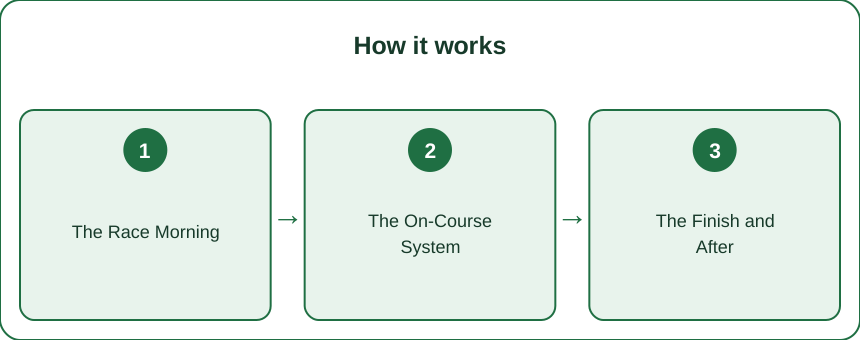
The Race Morning
The pre-start hours: the arrival math (the 90-minutes-early standard — the parking-shuttle-registration pipeline at big events; the wave time treated as a boarding call), the kit strategy (the race outfit worn arriving — the fitted synthetics and drainage-happy trail shoes from the training doctrine; the CHANGE KIT being the day’s genius move: the full dry outfit, towel, plastic bags and wet-bag for after), the bag-drop protocol (the valuables minimized, the drop bag packed in layers — the post-race items on top), the fueling timeline (the familiar breakfast three hours out, the banana-and-sips final hour — the fuel doctrine’s race-morning standard; the porta-potty queue budgeted), the warm-up (the ten-minute jog-and-mobility ramp from the warm-up doctrine — the first obstacles arriving fast; the cold-start wall being a shoulder risk), and the wave-start culture (the corral energy, the MC rituals, the strangers who’ll boost you over walls in an hour — the community doctrine in face paint).
The On-Course System
Managing the race: the pacing law (the opening kilometer at deliberate restraint — the excitement tax from the pacing doctrine; the obstacle queues as built-in recovery accepted, not raged at), the grip-account budgeting (the hang-heavy obstacles spaced by the course map — the grip saved early for the late rigs; the carry segments walked with purpose), the obstacle approach ritual (the ten-second watch of the person ahead — the technique reminder from the skills doctrine; the commit-fully rule: the hesitation mid-rig being the classic fail), the failure management (the failed obstacle’s penalty done with rhythm and released — the one-obstacle race not becoming the whole race; the retry decision made by grip-account balance), the fuel-and-water stations (the sips at every station on hour-plus courses — the gel at the hour mark per the fuel doctrine), the mud craft (the low center of gravity on slick terrain, the shoe-sucking mud walked toes-up — the falls kept playful; the technique doctrine, moistened), and the buddy dynamics (the pack that regroups after obstacles — the boost-and-be-boosted economy from the team doctrine).

The Finish and After
The post-fire-jump protocol: the finish rituals (the fire-jump photo, the medal, the banana — the moment savored before logistics resume), the immediate recovery (the walk-down cool-off, the water-and-snack within thirty minutes per the recovery doctrine; the hose-station queue braved: the mud removed before it cements), the change ceremony (the dry-kit transformation being race day’s second-best moment — the plastic-bag shoe storage, the wet-bag containment; the warm layers even in summer: the post-race chill being real), the drive-home safety (the towel-on-seat prep, the caffeine-and-snack alertness check after a depleting morning), and the same-day care (the shower-and-scrape inspection — the cuts cleaned per the first-aid doctrine; the scrapes covered; the tetanus-status thought from the outdoor doctrine).
The Recovery Week
After the adventure: the soreness forecast (the day-two DOMS in forearms, lats and the mysterious everything — the eccentric-and-novel loading from the DOMS doctrine; the walks and gentle movement as the cure), the gear rehab (the mud-caked shoes hosed and air-dried — the machine-wash question answered by the care doctrine: shoes no, kit yes with a pre-rinse; the gear inspected for retirement), the training resumption (the easy week following the race — the comeback doctrine’s gentle re-entry; the niggles from the course monitored), the debrief ritual (the race reviewed — the obstacles that beat you becoming the next block’s training targets per the plateau doctrine; the grip, wall or engine gap named), the photo-and-story economy (the mud photos shared, the friends recruited — the race’s best marketing being your grin; the team for next time assembled), and the booking honesty (the next-race registration within the week being the documented pattern — the hook from the training doctrine; the season planned while the medal’s still on the doorknob; the parking lot left already, half an athlete heavier and one adventure richer). Arrive early, budget the grip, pack the dry kit: the day, mapped mud to medal.
Arrive 90 minutes early with a full dry change-kit in the drop bag, open the race restrained, budget grip for the late rigs, and do failed-obstacle penalties with rhythm. The dry clothes after the hose station are race day’s second-best moment.
Keep Reading
This article is for general informational and styling purposes only. Fit, sizing, and product availability may vary.