Why Your Forearms Give Out Before Your Grip Does in Obstacle Races
Quick Answer: Forearm flexor fatigue, not hand grip strength itself, is usually the real limiter on hanging obstacles — the muscles that keep your fingers curled fatigue faster than your actual crushing grip strength, which is why your hands feel “fine” right up until they suddenly aren’t.
You train grip strength for months, and you still come off the monkey bars before you expected to. Your hands don’t feel weak — they just stop cooperating. That disconnect is a specific, well-documented fatigue pattern, not a training failure.

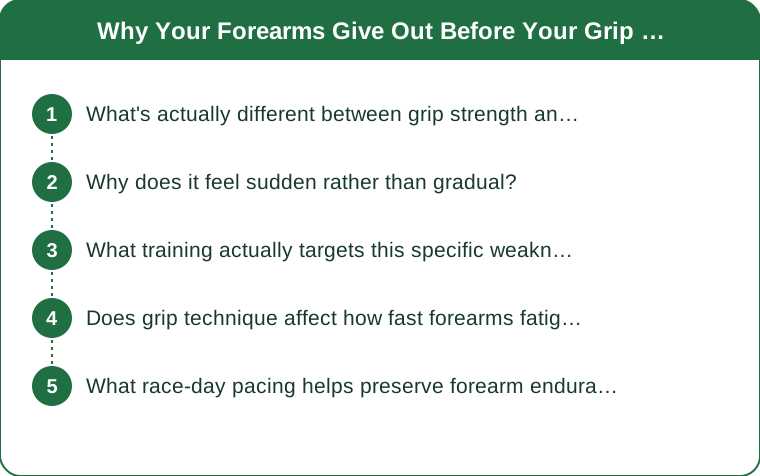
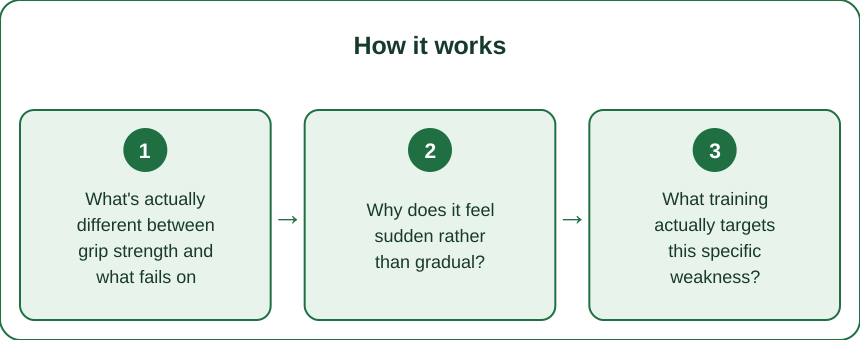
What’s actually different between grip strength and what fails on obstacles?
Grip strength as usually trained (dead hangs, grippers) measures peak crushing force. Sustained hanging and swinging obstacles instead demand endurance in the forearm flexor muscles that keep fingers curled over time — a different fatigue system than raw crushing strength, which is why strong-gripped athletes can still fail hanging obstacles.
Why does it feel sudden rather than gradual?
Forearm flexor fatigue tends to cross a threshold rather than decline smoothly — grip feels stable, then rapidly loses the ability to maintain curl tension within a few seconds once local muscle fatigue passes a certain point, which is why hanging obstacles can feel like an abrupt failure rather than a gradual one.

What training actually targets this specific weakness?
Sustained hangs (30-60+ seconds, not maximal-effort short holds) and dynamic movements like bar traverses build the endurance-specific adaptation that pure strength grippers don’t. Training duration under tension matters more here than training peak force.
Does grip technique affect how fast forearms fatigue?
Yes — an open, relaxed grip that only applies the minimum force needed to maintain contact fatigues slower than a tense, over-gripped hold. Many athletes unconsciously over-grip out of nervousness on an obstacle, burning through forearm endurance faster than the obstacle actually requires.
What race-day pacing helps preserve forearm endurance for later obstacles?
Shaking out hands and briefly relaxing grip during any non-hanging section between obstacles allows some forearm recovery — arriving at a grip-heavy obstacle with hands already fatigued from over-gripping earlier terrain is a common, avoidable mistake.
TL;DR:
- Forearm flexor endurance, not peak grip strength, usually limits hanging obstacles
- The failure feels sudden because local muscle fatigue crosses a threshold quickly
- Train sustained hangs and traverses, not just short maximal grip holds
- A relaxed, minimum-necessary grip preserves forearm endurance longer than an over-tight one
If your grip strength numbers look solid but obstacles still end early, the fix isn’t more crushing-strength training — it’s more time under sustained tension.
Keep Reading
This article is for general informational and styling purposes only. Fit, sizing, and product availability may vary.