Why Grip Fails Before Your Legs Do in Obstacle Races
Quick Answer: Grip fatigues faster than leg muscles during obstacle races mainly because forearm grip muscles are smaller and rely more heavily on isometric, sustained contraction (as opposed to the rhythmic contract-relax pattern of running), which depletes local muscle energy stores faster relative to their size than larger leg muscles working dynamically.
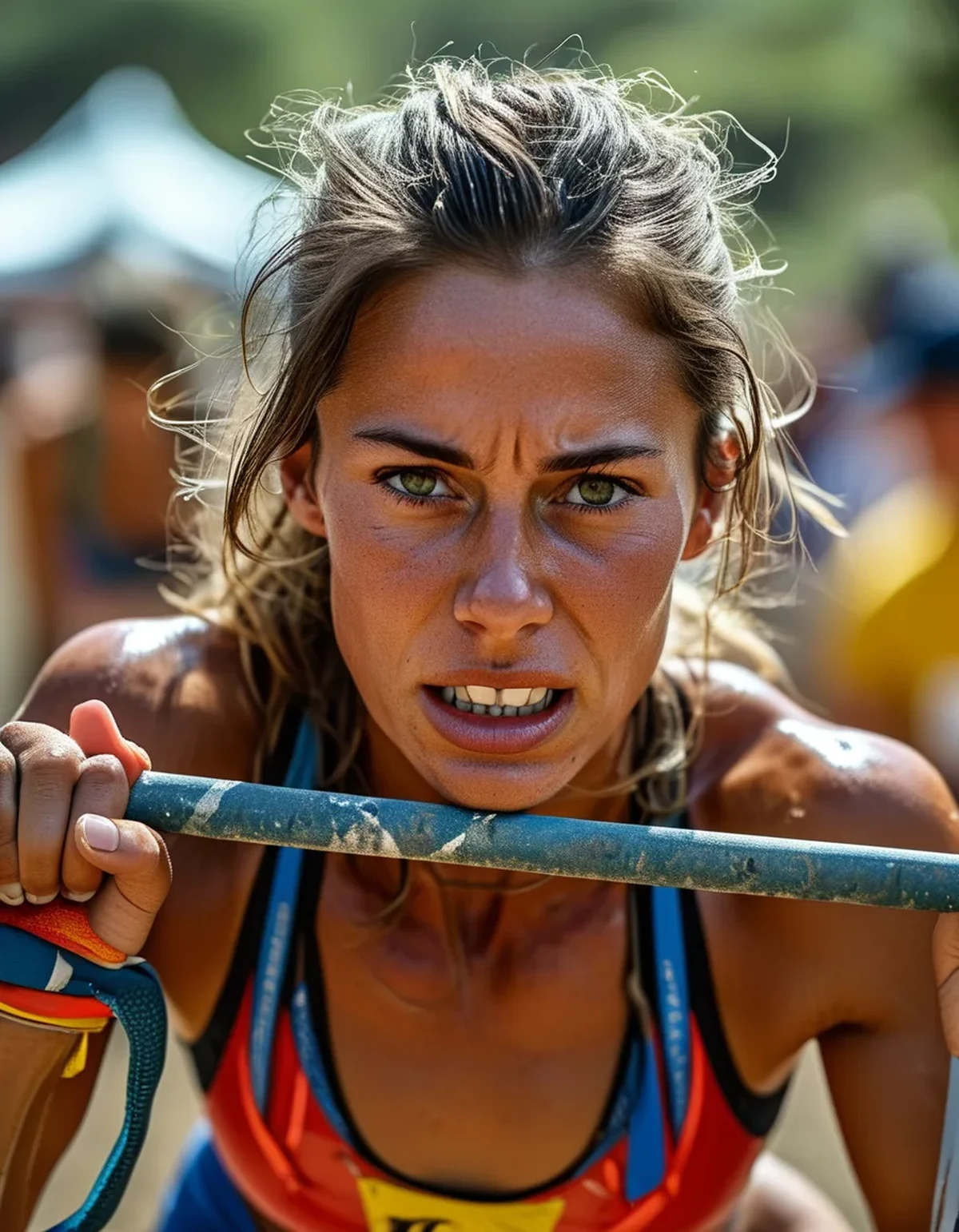
Legs can run for miles because running is a rhythmic, contract-relax movement. Grip on a rig or rope is closer to sustained squeezing — and sustained squeezing fatigues small muscles fast.

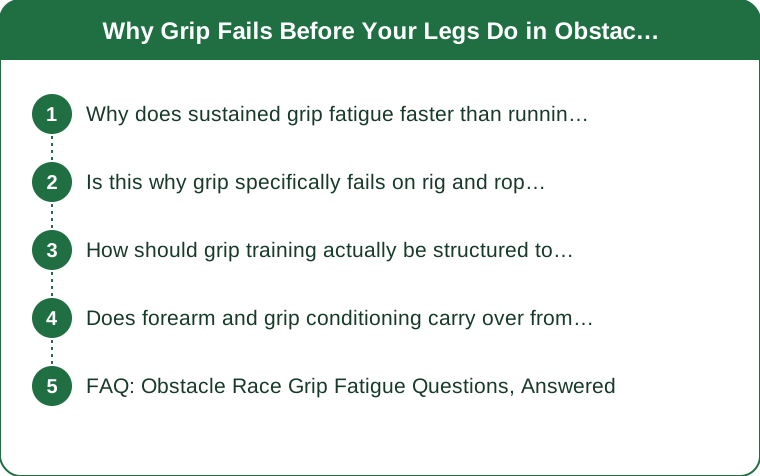
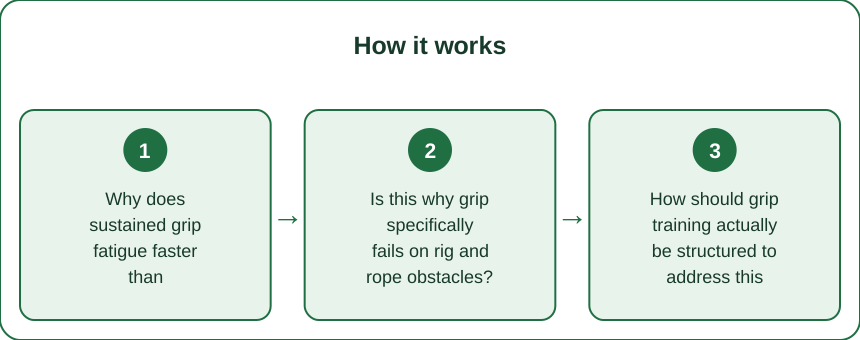
Why does sustained grip fatigue faster than running-style leg use?
Isometric or sustained muscle contractions, like gripping a bar, restrict blood flow to the working muscle more than rhythmic contract-relax movements like running, which limits oxygen and energy delivery exactly when the muscle needs it most.
Forearm grip muscles are also simply smaller in total mass than major leg muscle groups, giving them less total energy reserve to draw from before fatigue sets in.
Is this why grip specifically fails on rig and rope obstacles?
Rig and rope obstacles typically demand continuous or near-continuous grip for an extended stretch, which is exactly the sustained-contraction pattern that fatigues grip fastest — unlike a quick bar hang, there’s little opportunity for the brief releases that let blood flow return.
This is distinct from general hand strength — someone can have a strong grip in isolation and still fail on a rig simply due to this sustained-load fatigue pattern building up over a longer obstacle.
How should grip training actually be structured to address this specifically?
Training sustained hangs and farmer’s carries, rather than only quick grip-strength exercises, builds the specific muscular endurance that rig and rope obstacles actually demand.
Grip training that emphasizes time under sustained tension, gradually increasing hang or carry duration, more directly addresses race-day grip failure than isolated grip-strengthener devices alone.
Does forearm and grip conditioning carry over from other sports?
Climbing-style training carries over particularly well, since it involves similar sustained-grip demands under bodyweight or near-bodyweight load over extended periods.
Sports relying mainly on quick, repeated grip bursts (many racket sports, for instance) build a different grip quality than the sustained endurance OCR obstacles specifically demand.
FAQ: Obstacle Race Grip Fatigue Questions, Answered
How often should grip-specific training be added to an OCR training plan?
Most OCR coaches suggest two to three dedicated grip-endurance sessions per week, layered alongside regular running and strength training rather than replacing it.
Does chalk or grip aid meaningfully help with this fatigue pattern?
It helps with slippage from sweat, but it doesn’t address the underlying muscular fatigue mechanism, so training remains the primary fix.
Is grip fatigue worse in cold or wet race conditions?
Yes — cold reduces circulation to the hands further, and wet conditions add slippage on top of the underlying fatigue, compounding the challenge in cold-wet obstacle races specifically.
TL;DR:
- Sustained grip contractions restrict blood flow more than rhythmic leg movements like running
- Smaller forearm muscle mass gives grip less total energy reserve than major leg muscles
- Training sustained hangs and carries addresses this more directly than isolated grip exercises
- Climbing-style training carries over particularly well to rig and rope obstacle demands
Grip failing before the legs isn’t a strength problem in the usual sense — it’s a fatigue-pattern mismatch that targeted endurance training, not just general strength work, actually fixes.
Keep Reading
This article is for general informational and styling purposes only. Fit, sizing, and product availability may vary.