Why Your Grip Fails on Monkey Bars Before Your Arms Actually Get Tired
Quick Answer: Forearm grip muscles are smaller and fatigue faster under sustained isometric load than the larger arm and shoulder muscles doing the actual pulling work, which means grip failure — not arm strength — is usually the true limiter on monkey bars and similar hanging obstacles, and it responds specifically to dedicated grip endurance training rather than general arm strength work.
If your arms feel like they still had more to give when your grip suddenly let go, that’s grip endurance, not arm strength, running out first.

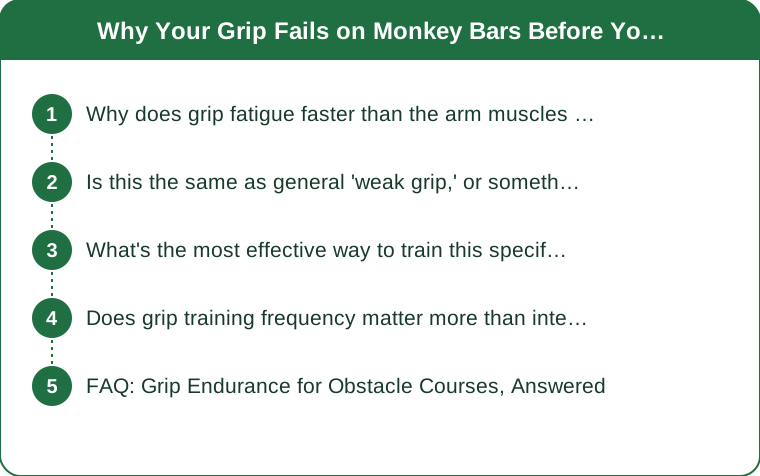
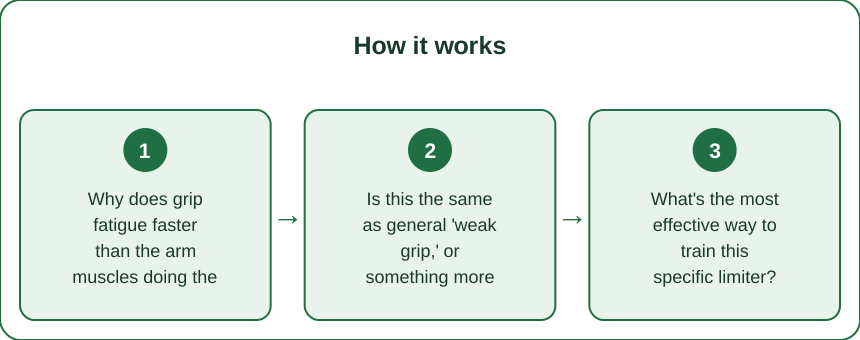
Why does grip fatigue faster than the arm muscles doing the pulling?
Forearm grip muscles are smaller and rely heavily on sustained isometric contraction to maintain hold, which fatigues faster under sustained load than the larger, more powerful muscles like the lats and biceps doing the actual pulling motion.
Is this the same as general ‘weak grip,’ or something more specific?
It’s more specifically about grip endurance under sustained load, not just raw grip strength. Someone can have a strong momentary grip (like a firm handshake) but still fail quickly under the sustained hanging load monkey bars require.

What’s the most effective way to train this specific limiter?
Dead hangs held for time, and farmer’s carries with progressively heavier weight, both train sustained grip endurance directly, which transfers more specifically to monkey bar and hanging obstacle performance than general arm exercises alone.
Does grip training frequency matter more than intensity here?
Grip muscles generally recover faster than larger muscle groups, which means more frequent, shorter grip-specific sessions often build endurance capacity faster than infrequent, all-out sessions alone.
FAQ: Grip Endurance for Obstacle Courses, Answered
How long should a dead hang be to build meaningful grip endurance?
Starting with hangs to near failure and progressively increasing hold time over weeks builds endurance more effectively than a single fixed target time.
Does chalk actually help with this, or just mask the real issue?
Chalk improves grip friction and can meaningfully extend hold time on sweaty or humid obstacle days, complementing rather than replacing actual grip training.
Do grip trainers or hand grippers help for monkey bar specific performance?
They help general grip strength, but hanging-specific exercises like dead hangs transfer more directly to monkey bar endurance specifically.
TL;DR:
- Grip muscles are smaller and fatigue faster under sustained load than the larger pulling muscles
- This is a grip endurance issue specifically, not the same as general grip strength
- Dead hangs and farmer’s carries train the sustained-load capacity monkey bars actually require
- More frequent, shorter grip sessions often build capacity faster than infrequent max-effort ones
Keep Reading
This article is for general informational and styling purposes only. Fit, sizing, and product availability may vary.