Why Your Grip Always Fails on the Same Obstacle, Race After Race
Quick Answer: Grip failing on the same obstacle repeatedly usually points to a specific grip-type weakness (crimp, pinch, or sustained hang) that obstacle happens to demand more than others on the course, not general grip fatigue. Identifying which grip type that specific obstacle requires and training it directly closes the gap faster than generic grip training.
If it’s always the same obstacle that ends your race, that’s not random bad luck showing up at the same spot — it’s a specific grip weakness getting exposed by a specific demand.

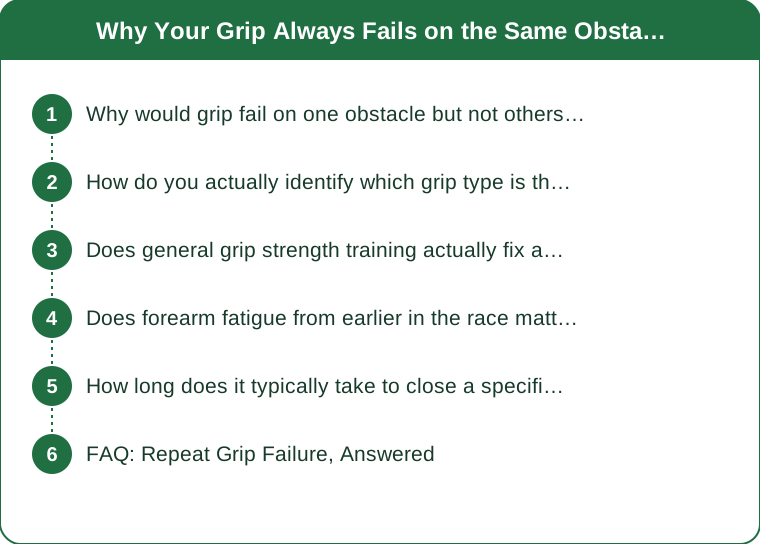
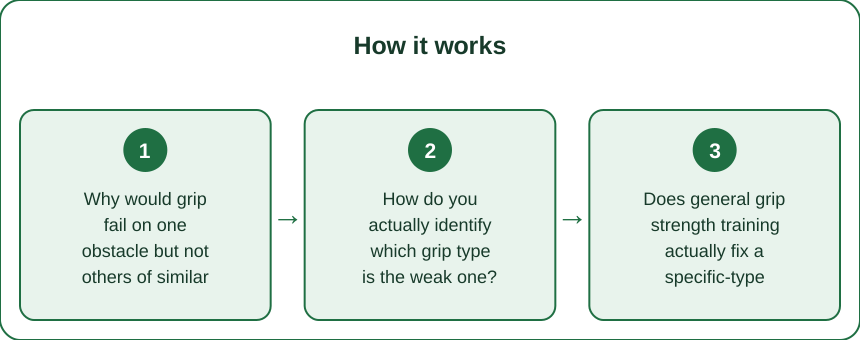
Why would grip fail on one obstacle but not others of similar difficulty?
Different obstacles demand genuinely different grip types — monkey bars and rings demand sustained dynamic grip endurance, a rope climb demands a different pinch-and-squeeze pattern, and a peg board demands precise finger strength. A person can have strong grip in one category and a real weakness in another, which shows up as consistent failure on obstacles matching that specific weak category.
How do you actually identify which grip type is the weak one?
Tracking which specific obstacles cause failure across multiple races, then categorizing them by grip demand (hanging/dynamic, pinching, crimping, or gripping under rotation) reveals the pattern more reliably than assuming general grip fatigue — most repeat-failure patterns cluster around one or two grip categories once mapped out this way.
Does general grip strength training actually fix a specific-type weakness?
Only partially — generic grip training (like a hand gripper tool) mostly builds crushing grip strength, which doesn’t transfer well to sustained hang or dynamic swinging grip demands. Training needs to match the specific grip pattern of the problem obstacle — dead hangs and bar-to-bar swings for hanging obstacles, pinch blocks for pinch-grip obstacles — to close that specific gap.

Does forearm fatigue from earlier in the race matter more than raw grip strength?
Often, yes — cumulative forearm fatigue from earlier obstacles and general running grip (carrying items, gripping poles) can be the actual limiting factor, not the target obstacle’s difficulty in isolation. This is why some athletes train grip-specific endurance under pre-fatigued conditions, simulating late-race grip demand rather than testing fresh grip strength alone.
How long does it typically take to close a specific grip weakness?
Consistent, obstacle-specific grip training 2-3 times weekly for 6-8 weeks is a commonly cited timeline for meaningful improvement in a targeted weak grip pattern — grip endurance responds relatively quickly to specific training compared to some other strength adaptations, provided the training actually matches the failure pattern identified.
FAQ: Repeat Grip Failure, Answered
Does chalk or grip aids fix an underlying weak grip pattern?
They can help marginally with friction, but they don’t address an underlying strength or endurance gap in a specific grip type — they’re a supplement to training, not a substitute for it.
Should you avoid practicing the exact obstacle that fails you, out of frustration?
No — deliberately practicing the specific movement pattern (even a simplified version) is more effective than avoiding it, since avoidance doesn’t address the underlying grip-type gap.
Does hand size or finger length actually matter for specific obstacles?
It can for some obstacles like peg boards or specific hold shapes, but training the relevant grip pattern still produces meaningful improvement regardless of hand size differences.
TL;DR:
- Repeat obstacle failure usually points to one specific grip-type weakness, not general fatigue
- Different obstacles demand different grip types: hanging, pinching, crimping, or rotational grip
- Generic grip tools mostly build crushing strength, which doesn’t transfer to hanging or dynamic grip
- Training the specific grip pattern that matches the failing obstacle closes the gap in 6-8 weeks
The obstacle isn’t cursed — it’s diagnostic. Once you know which grip type it demands, train that pattern directly instead of grip training in general.
Keep Reading
This article is for general informational and styling purposes only. Fit, sizing, and product availability may vary.